
Blog
Donating Equipment in Michigan for a Tax Deduction: What Form 8283 Requires
Donating surplus machinery or tools to a Michigan charity or trade school can earn a real tax deduction, but claims over $5,000 require a qualified appraisal and IRS Form 8283, Section B. Here's what Michigan business owners need to document the gift and support the value.
A shop closing out a tool crib, a manufacturer upgrading its line, or a contractor retiring older machinery all have the same question once they decide to donate instead of scrap or auction: what does the IRS actually require to claim the deduction? The answer depends almost entirely on dollar amount. Below $500 the rules are light. Above $5,000 the IRS wants a qualified appraisal and a completed Form 8283, Section B, signed by the appraiser and the donee. Getting this sequence wrong is the single most common reason a charitable equipment deduction gets reduced or denied on audit.
Our Michigan equipment appraisal services support donors through exactly this process: establishing fair market value for used machinery, tools, and shop equipment, and preparing the qualified appraisal the IRS requires once a claimed deduction crosses $5,000.
Choosing a Michigan Recipient and Confirming Its Status
The deduction only works if the recipient qualifies under Internal Revenue Code Section 170(c), and the donor, not the recipient, bears the burden of proof if that status is ever questioned. Before equipment leaves the dock, confirm the organization's exempt status and get a written sense of how the equipment will actually be used.
Michigan has no shortage of realistic homes for donated tools and shop equipment:
- Habitat for Humanity ReStore locations, of which Habitat Michigan operates more than 50 statewide, accept tools, building materials, and appliances. The Macomb Habitat for Humanity ReStore in Shelby Township specifically lists tools among its accepted donations.
- Goodwill of Greater Grand Rapids and Goodwill of Southeastern Michigan both take tools and hardware through their regional donation and resale programs.
- A Kalamazoo nonprofit makerspace accepts donated hand tools, power tools, electronics, and workshop equipment for community use.
- Michigan community colleges with skilled trades programs, including Henry Ford College, Washtenaw Community College, Macomb Community College, Grand Rapids Community College, and Lansing Community College, are realistic recipients for welding, automotive, and machining equipment.
Community colleges in particular have formal gift-acceptance procedures that run through a foundation or development office, separate from the academic department that would actually use the equipment. Contact that office and the purchasing department before you transfer title. A machine sitting unused in a hallway because no department requested it, or because the college's insurance and liability review flagged it, does nothing for your deduction and nothing for the school.
This matters for more than paperwork. Under Section 170(e)(1)(B)(i), tangible personal property donated for a use unrelated to the recipient's exempt purpose can have its deduction limited to the donor's tax basis rather than its fair market value. A CNC machine donated to a community college's machining lab is a related use. The same machine donated to an organization that simply sells it at auction may not be. Get the intended use in writing from the recipient before you finalize the gift.
Determining Fair Market Value for Used Shop Equipment
The deduction is based on fair market value: the price a willing buyer and willing seller would agree on, with neither under compulsion and both reasonably informed, according to IRS Publication 561. For donated machinery, that is almost never the same number as the asset's depreciated book value, its original purchase price, or its replacement cost new.
An appraiser arriving at fair market value for a lathe, a forklift, or a bank of shop tools typically works through:
- Comparable sales. Recent transactions for similar make, model, and condition in the used-equipment market, adjusted for age and capacity.
- Condition and maintenance history. Operating status, missing components, and whether the equipment has been well maintained or run to failure.
- Remaining useful life. How many more years of productive service the asset realistically has left.
- Obsolescence. Whether newer technology has reduced demand for the specific model, even if it still functions.
Book value and insurance value are not substitutes for an independent market-based opinion, and neither is a donor's own estimate once the claimed deduction crosses the $5,000 threshold. Our appraisers hold credentials with organizations such as the American Society of Appraisers, the Certified Appraisers Guild of America, and NEBB, and prepare reports in accordance with the Uniform Standards of Professional Appraisal Practice published by The Appraisal Foundation.
The $5,000 Threshold and Form 8283, Section B
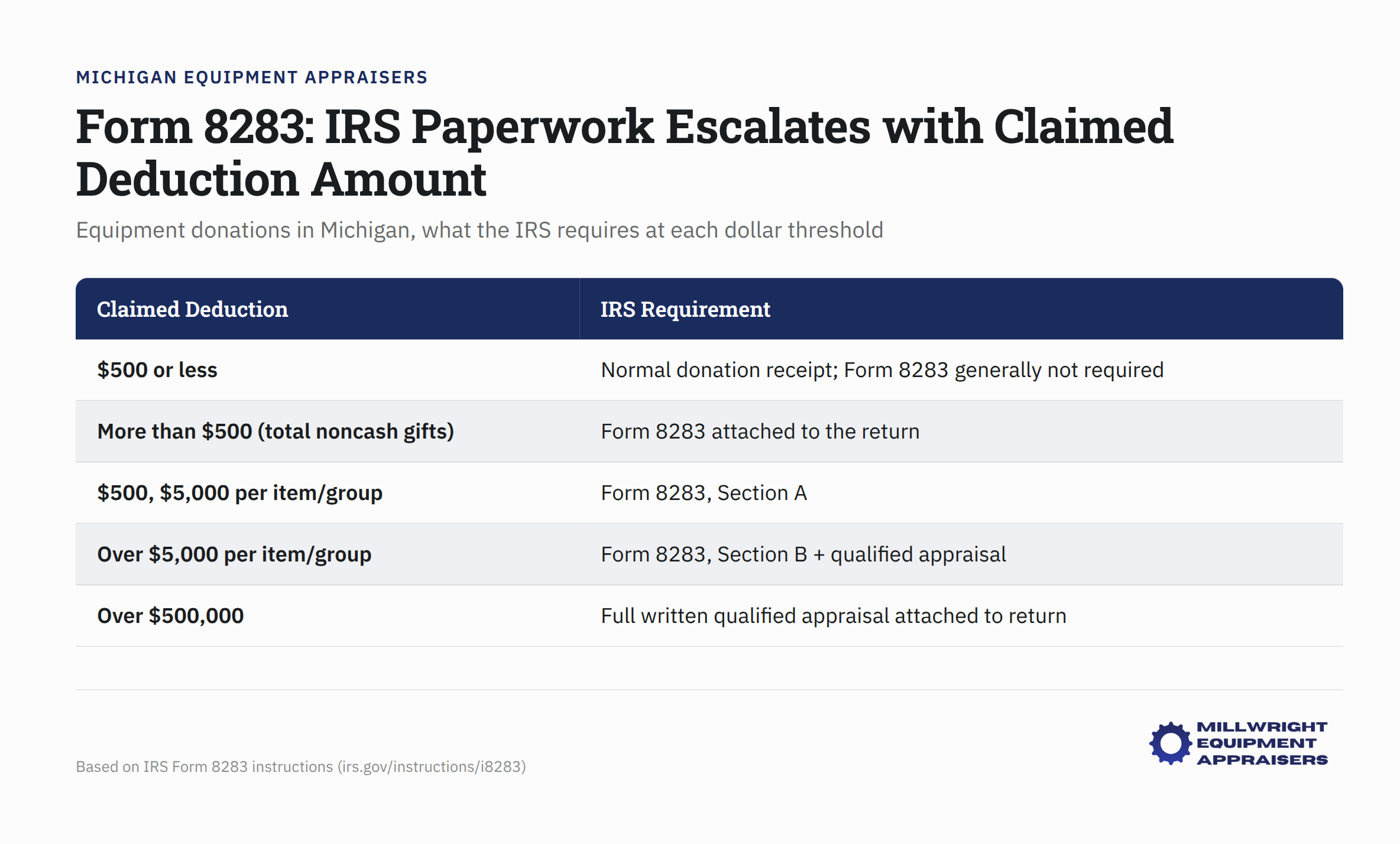
The dollar amount of the claimed deduction, not the type of equipment, determines what paperwork the IRS requires. The IRS Form 8283 instructions lay out a clear escalation:
| Claimed deduction | What the IRS requires |
|---|---|
| $500 or less | Normal donation receipt; Form 8283 generally not required for this item alone |
| More than $500, total noncash gifts | Form 8283 attached to the return |
| More than $500 but not more than $5,000 per item or group | Form 8283, Section A |
| More than $5,000 per item or group of similar items | Form 8283, Section B, plus a qualified appraisal |
| More than $500,000 | The full written qualified appraisal attached to the return, not just the form |
Section B has to be signed by the donor, the qualified appraiser, and the donee organization. The donee's signature only acknowledges receipt of the property; it is not an endorsement of the claimed value. A separate Form 8283 and a separate qualified appraisal are generally required for each item of donated property, except where a group of similar items is treated as a single unit under the aggregation rule described below.
The Qualified Appraisal Rule: Who, What, and When
Once a claimed deduction passes $5,000, the appraisal itself has to meet specific requirements, not just the form. A qualified appraiser is someone who regularly performs appraisals for compensation, meets education and experience requirements for the type of property being valued, and has no prohibited relationship to the donor or the donee, such as being the donor's employee or the party who sold the equipment to the donor.
Timing is just as strict as who signs the report. IRS Publication 561 requires the appraisal to be dated no earlier than 60 days before the date of the contribution, and the donor must receive the completed appraisal before the due date, including extensions, of the return on which the deduction is first claimed. An appraisal commissioned too far in advance of the gift, or one that shows up after the filing deadline, does not satisfy the rule even if the valuation itself is sound.
Watch out: A donor who waits until February to think about a December 31 donation can find there isn't enough time to schedule the appraisal, complete the report, and still receive it before the return is due. Build the appraisal into the donation timeline, not after it.
We quote engagement fees for this work as a fixed fee after scoping the equipment and the intended use, never by the hour. For machinery and equipment appraisals, an IRS-qualified report for charitable donation purposes is quoted from $395, with the final fee set by the number of assets, the completeness of maintenance and purchase records, and the depth of market research the valuation requires. Our equipment appraisal request page walks through what we need from you to scope the engagement.
The Aggregation Rule for Groups of Similar Items
Many Michigan equipment donations are not a single machine but a collection: a set of hand tools, a run of shop stools and workbenches, or several smaller power tools donated to the same organization. The IRS treats these as a group of similar items for threshold purposes, meaning the $5,000 figure applies to the combined value of the group, not to each individual piece.
Example: A machine shop donates 40 hand tools to a Kalamazoo nonprofit makerspace. No single tool is worth more than $200, but the combined fair market value of the group is $6,200. Because the group exceeds $5,000 in total, the donor needs a qualified appraisal and Form 8283, Section B, even though no individual item crosses the threshold on its own.
A single qualified appraisal can cover an entire group of similar items contributed to the same donee in the same tax year, as long as it includes the required information for each item in the group. If equipment goes to more than one recipient and the combined claimed deduction exceeds $5,000, a separate Form 8283 is required for each donee.
Timing Your Year-End Equipment Donation
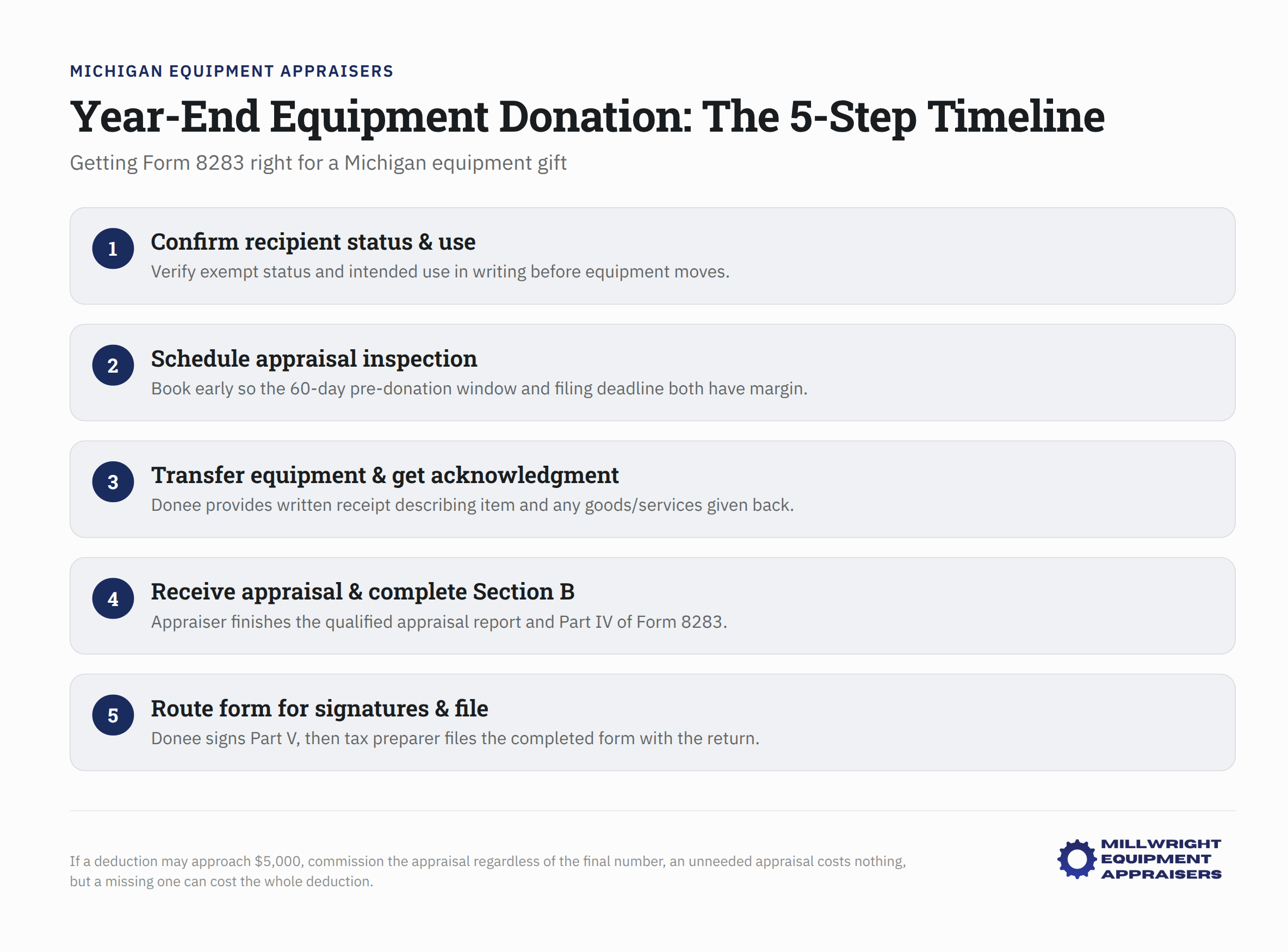
December is the busiest month for equipment donations, and it is also the month where timing mistakes are most common. A workable sequence for a year-end gift looks like this:
- Confirm the recipient's exempt status and intended use, in writing, well before the equipment moves.
- Schedule the appraisal inspection early enough that the 60-day window before the contribution date, and the return deadline afterward, both have comfortable margin.
- Transfer the equipment and obtain a written acknowledgment from the donee describing what was received and whether any goods or services were provided in return.
- Receive the completed qualified appraisal report and have the appraiser complete Section B, Part IV of Form 8283.
- Route the signed form to the donee for Part V, then to your tax preparer** for filing with the return.
If a deduction is likely to land anywhere near $5,000, it is worth commissioning the appraisal regardless of exactly where the final number lands. An appraisal completed for a claim that turns out to be $4,800 costs you nothing in IRS compliance; an audit of a $5,200 claim with no appraisal at all can cost the entire deduction.
Document the Gift Before You Move the Equipment
A donated forklift, a welding station, or a pallet of hand tools can genuinely support a valuable charitable deduction for a Michigan business, but the IRS puts the burden of proof entirely on the donor. Confirm the recipient's status and intended use, get a market-based fair market value from a qualified appraiser once the claim exceeds $5,000, and keep the appraisal dated and filed on the IRS's timeline rather than your own. Our appraisers prepare IRS-qualified reports for machinery, tools, and shop equipment donated throughout Michigan, and we're glad to walk through the scope and fee before any inspection is scheduled.
This article is provided for general informational purposes only and does not constitute legal, tax, or financial advice. Readers should consult a qualified attorney or CPA regarding their specific circumstances.