
Blog
Michigan Estate Tax and Equipment: What Detroit and Grand Rapids Executors Must Know
Michigan has no state estate tax, but executors handling equipment-heavy estates in Detroit and Grand Rapids still need a defensible, date-of-death fair market value appraisal for probate inventory and federal estate tax purposes alike.
Settling an estate that includes a machine shop, a fleet of farm equipment, or a warehouse of commercial gear raises a question we hear constantly from Michigan personal representatives: does the state tax any of this, and if not, why does the equipment still need a real appraisal? The short answer is that Michigan does not tax the estate itself, but the probate court and, for larger estates, the IRS both require a documented fair market value for every asset, equipment included. This guide walks through what executors in Detroit, Grand Rapids, and the rest of Michigan actually owe, and when a professional equipment appraisal service protects the estate from costly guesswork.
Does Michigan Have an Estate Tax?
No. Michigan repealed its standalone estate tax years ago, and it has had no state inheritance tax for deaths occurring after 1993, so an estate opened today owes nothing to the state of Michigan on the transfer itself (Michigan estate and inheritance tax overview). The old Michigan Estate Tax Act is still sitting on the books at MCL 205.201 et seq., but that statute was tied to a federal credit that no longer exists, so it has no practical effect on a 2026 estate (Michigan Estate Tax Act text). Executors sometimes assume the repeal means equipment values don't matter anymore. That assumption is wrong, and it's the single most common misstep we see in estates with shop or farm machinery.
What the repeal actually means is that Michigan estates are governed by two separate tracks instead of three: the federal estate tax (which only applies above a high threshold) and Michigan's own probate inventory duty (which applies to nearly every estate, regardless of size).
The Federal Estate Tax Threshold for 2026
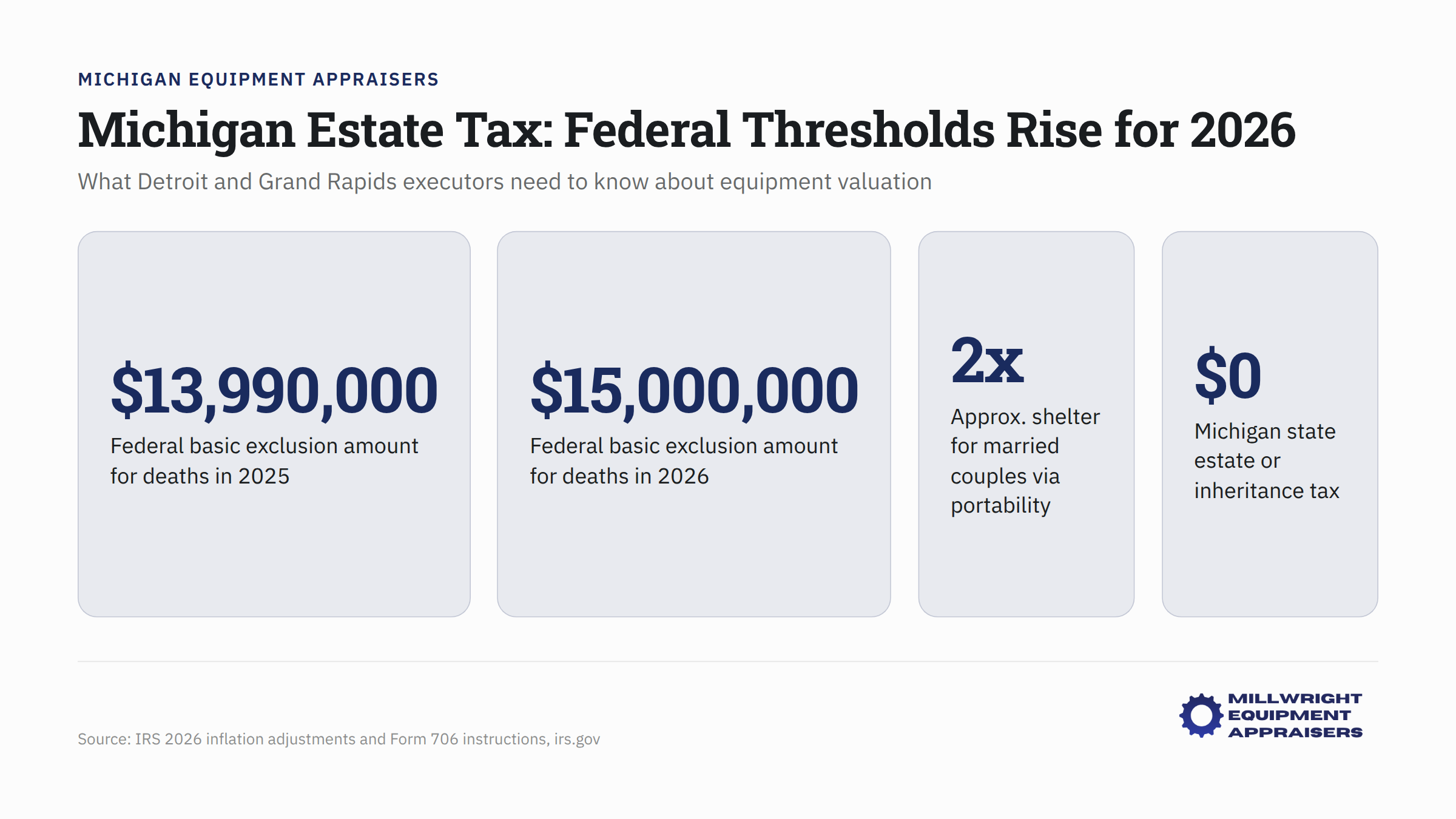
Most Michigan estates with equipment fall well under the federal filing threshold, but the executor still has to prove that, and proving it requires a real valuation. For decedents dying in 2026, the federal basic exclusion amount is $15,000,000 per individual, up from $13,990,000 for deaths in 2025 (IRS 2026 inflation adjustments). A married couple can shelter roughly double that amount through portability. Only estates whose gross value, including equipment, real estate, business interests, and investments, exceeds that number owe federal estate tax or must file IRS Form 706 (Form 706 instructions).
That said, "under the threshold" does not mean "skip the appraisal." An executor can't know whether an estate is under $15 million without first establishing what every asset is worth, equipment included. A shop full of CNC machines, a fleet of tractors, or a line of commercial kitchen equipment can carry real value that heirs, the probate court, and in some cases the IRS will all expect to see documented.
Fair Market Value: The Standard That Governs Both Filings
Federal tax regulations define fair market value as the price at which property would change hands between a willing buyer and a willing seller, with neither party under any compulsion to buy or sell and both reasonably informed of the relevant facts (). That standard explicitly excludes a forced or fire-sale price, which matters because equipment liquidated quickly at an estate sale rarely reflects what the same machine would bring in an orderly transaction between informed parties.
The default valuation date is the date of death. An executor may elect the alternate valuation date under IRC Section 2032, which shifts the valuation point to six months after death, but only if that election reduces both the gross estate and the resulting estate tax. Any asset sold, distributed, or disposed of before the six-month mark has to be valued as of the date it changed hands instead (Form 706 instructions). For most equipment-heavy estates we work with, the date-of-death value is the one that matters, since the alternate date is only relevant when estate tax is actually owed.
Michigan's Probate Inventory Still Requires a Real Number
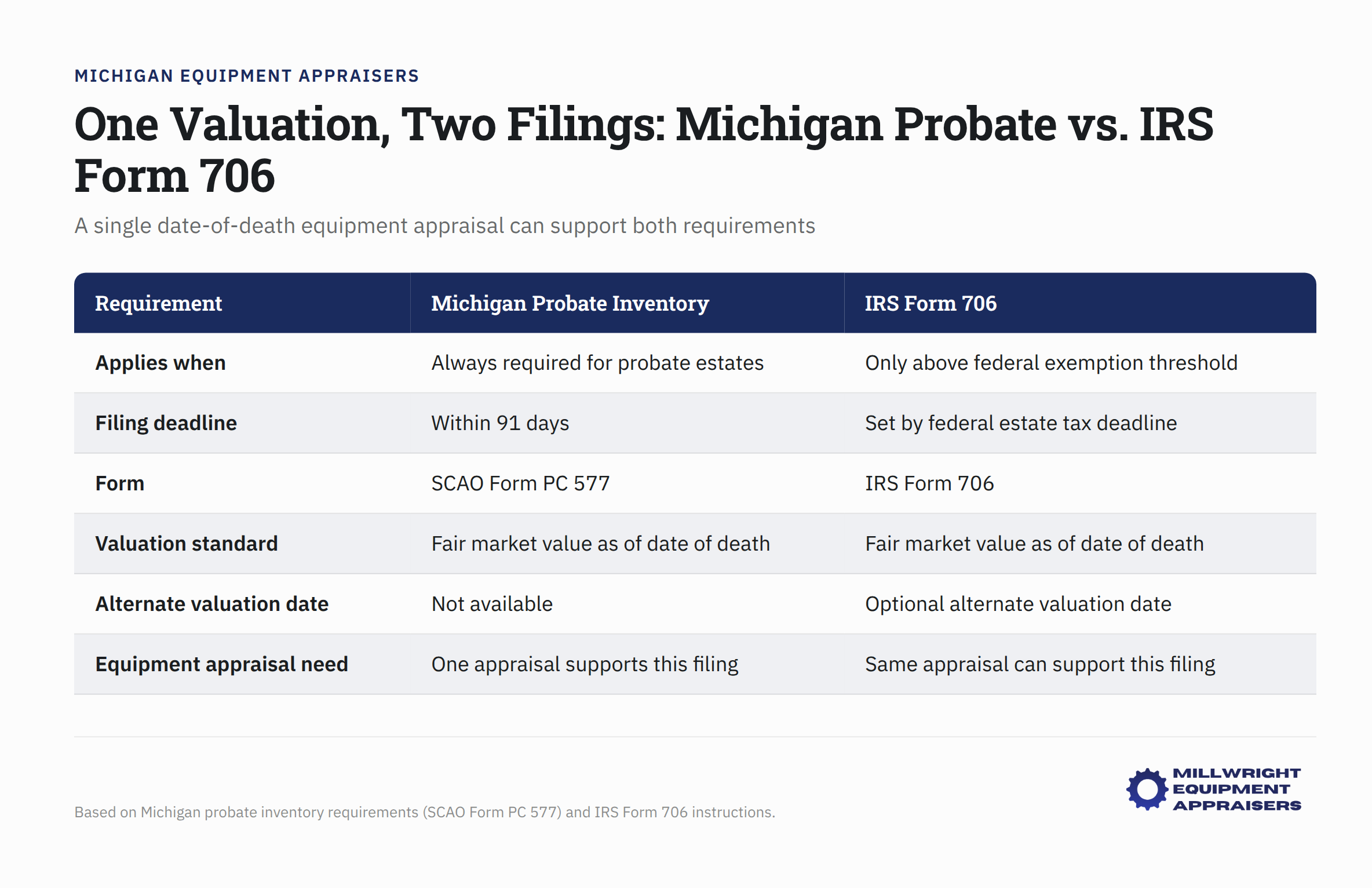
Even when no federal return is ever filed, Michigan law requires the personal representative to file or serve an inventory of the decedent's property within 91 days of appointment. That inventory has to describe each asset in reasonable detail and state its fair market value as of the date of death, along with any liens or encumbrances against it. The standard court form used across Michigan probate courts is SCAO form PC 577.
This is the requirement that catches a lot of executors off guard. They assume the inventory is a formality they can fill in from memory or a rough guess, and for cash, securities, and household goods that's often close enough. Equipment is different. A used forklift, a dairy parlor system, or a CNC lathe doesn't have a quoted market price the way a stock does, and an executor's informal estimate rarely survives a challenge from an heir who thinks the number is too low, or scrutiny if the estate is ever audited.
Two Filings, One Valuation Date
The good news is that executors aren't juggling two different valuation standards. Both the Michigan probate inventory and, where applicable, IRS Form 706 ask for the same thing: fair market value as of the date of death. A single, properly documented equipment appraisal performed as of that date can support both filings at once, which saves the estate from paying for duplicate work later.
What a Defensible Equipment Appraisal Actually Documents
A report built to withstand probate court review or IRS scrutiny needs more than a number on a page. At minimum, it should identify:
- The specific asset, including manufacturer, model, serial number, and year of manufacture
- Physical condition, operating status, and maintenance or repair history
- Attachments, accessories, and any installed modifications
- Ownership status, including outstanding liens, leases, or financing
- Whether the equipment is in active use, idle, or obsolete
- The valuation date and whether an alternate date was elected
- The valuation premise applied, such as continued use or orderly liquidation
- Comparable sales, dealer data, and auction results supporting the conclusion
- The appraiser's qualifications, methodology, scope, and limiting conditions
Watch out: Online listing prices and dealer asking prices are not completed sales. Using them without adjustment is one of the fastest ways an informal equipment estimate falls apart under review.
Pro tip: If the estate includes financed or leased equipment, note the outstanding balance separately from the appraised value. The probate inventory calls for both the asset's fair market value and any encumbrance against it, and conflating the two understates the net value of the estate.
Equipment We See Most Often in Detroit and Grand Rapids Estates
The equipment that shows up in Michigan estates tends to reflect the regional economy. In and around Detroit, we're regularly asked to value automotive shop equipment, metalworking and fabrication machinery, and small manufacturing lines tied to a family business. Grand Rapids carries its own legacy, with estates that include furniture manufacturing equipment, woodworking machinery, and commercial office or warehouse equipment left over from a closed operation. Farm equipment appraisals come up across the rest of the state, particularly in estates that include working farmland alongside tractors, combines, and irrigation systems.
The common thread across all of these is that the equipment rarely trades on a public market the way securities do, which is exactly why a documented, date-of-death appraisal carries more weight than an executor's best guess. If the estate also involves donating any of this equipment to a qualified charity rather than selling it, our guide on what Form 8283 requires for equipment donations in Michigan covers the separate documentation rules that apply in that scenario.
Special-Use Valuation and Why It Rarely Applies to Machinery
Executors handling farm estates sometimes ask whether special-use valuation under IRC Section 2032A, which lets certain farm and closely held business real estate be valued below its highest-and-best-use price, can be extended to machinery. For 2026, the special-use valuation reduction is capped at $1,460,000 (Form 706 instructions). That provision is written for qualifying real property, not for tractors, implements, or shop equipment. Machinery is still valued at ordinary fair market value even when it supports a farm or business that otherwise qualifies for the special-use election.
Protecting the Estate With One Clean Valuation
Because Michigan no longer imposes its own estate tax, the pressure on executors has shifted entirely to documentation. The probate court wants a defensible date-of-death value within 91 days of appointment. The IRS wants the same standard if the estate crosses the federal threshold. Heirs, lenders, and the courts all benefit when that number comes from a qualified appraiser rather than an executor's estimate, especially for equipment that doesn't have a ready market price.
Our equipment appraisal services are built around exactly this situation: a fixed-fee, USPAP-compliant valuation dated to the decedent's date of death, documented well enough to support both the Michigan probate inventory and an IRS Form 706 filing if one becomes necessary. If you're serving as a personal representative for an estate with machinery, shop equipment, or farm assets anywhere in Michigan, request an appraisal before the 91-day inventory deadline closes in on you.
This article is provided for general informational purposes only and does not constitute legal, tax, or financial advice. Readers should consult a qualified attorney or CPA regarding their specific circumstances.