
Blog
Michigan Business Personal Property Tax: How Equipment Appraisals Support Your Appeal
Michigan business personal property tax turns on true cash value, and an independent equipment appraisal gives you evidence a mass-appraisal depreciation table can't. This guide walks through Form 632, the small business exemption, and how to appeal an overvalued machinery assessment through the Board of Review and Michigan Tax Tribunal.
If you own a manufacturing shop, a construction fleet, or a working farm in Michigan, your machinery and equipment get taxed every year right alongside your buildings. When the local assessor's valuation of that equipment runs high, the gap between what they say it's worth and what it's actually worth can cost thousands of dollars annually. An independent equipment appraisal is often the single most effective piece of evidence a business owner can bring to a Board of Review hearing or a Michigan Tax Tribunal filing, and understanding the filing calendar is just as important as the appraisal itself.
Our Michigan equipment appraisers prepare USPAP-compliant valuations specifically for business personal property tax disputes, and this guide covers what gets taxed, when to file, how the small business exemption works, and what makes an appraisal persuasive to an assessor or a tribunal judge.
What Michigan Taxes as Business Personal Property
Michigan's General Property Tax Act generally taxes tangible personal property used in a business, which includes machinery, equipment, furniture, fixtures, and similar assets held for commercial or industrial use. This is separate from the real estate tax on your building or land; it's a distinct line item tied to the equipment itself.
Under Michigan's constitutional framework, property is assessed at 50% of its true cash value. For equipment, that means the real question behind every assessment notice is: what is this specific machine actually worth as of the valuation date, not what a generic depreciation table says it should be worth after a few keystrokes.
The relevant valuation date for personal property is generally December 31 of the preceding year. A 2026 assessment, in other words, reflects equipment owned, leased, or possessed as of December 31, 2025. That date matters because it anchors everything an appraiser evaluates: age, condition, obsolescence, and market comparables all get measured as of that single point in time.
Filing Your Annual Personal Property Statement (Form 632)
Michigan businesses report taxable equipment each year on the Personal Property Statement, commonly known as Form 632. The form requires property to be listed by category and acquisition year, and the assessor uses that reported cost, run through a standardized depreciation table, to calculate taxable value.
Form 632 is due to the local assessor by February 20 of the tax year. Missing that deadline doesn't exempt you from tax; it typically means the assessor estimates your equipment's value without your input, which tends to produce a higher number than a complete, accurate rendition would.
Pro tip: Keep your fixed-asset ledger current throughout the year. When February rolls around, you want acquisition dates, original costs, and disposal records ready to go rather than reconstructed from memory.
The Small Business Taxpayer Exemption: Does Your Equipment Qualify?
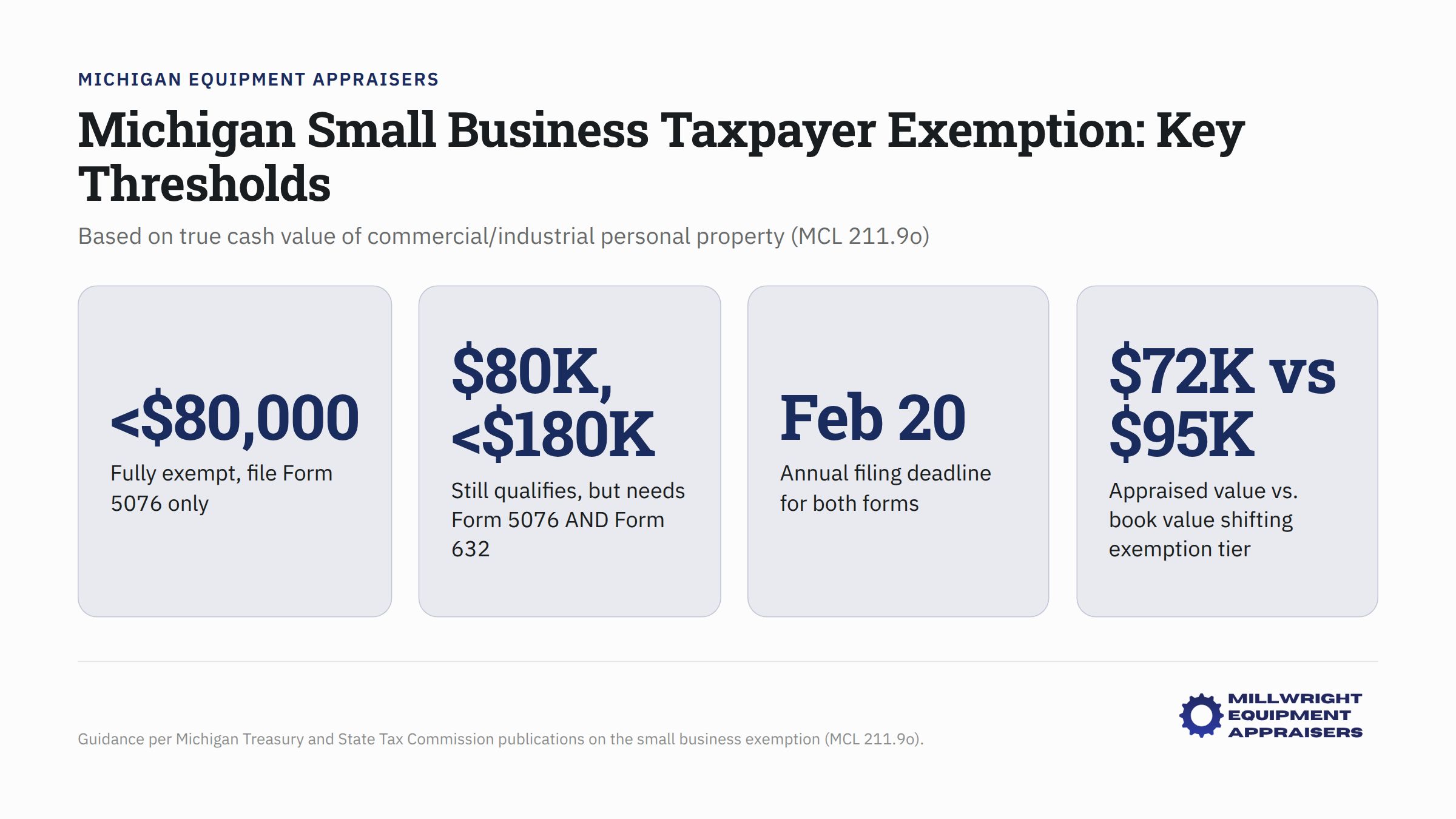
Michigan offers a full exemption from personal property tax for qualifying small businesses under MCL 211.9o, often called the Small Business Taxpayer Exemption. If the combined true cash value of all commercial and industrial personal property you own, lease, or possess in a given local tax collecting unit is less than $80,000, that property can be fully exempt.
To claim it, a business generally files Form 5076 with the local assessor by February 20, the same deadline as Form 632. If your combined true cash value falls at or above $80,000 but stays under $180,000, you may still qualify, but you generally have to file both Form 5076 and Form 632 every year rather than Form 5076 alone. The Michigan Treasury and State Tax Commission publish detailed guidance on how this small business exemption works, including the related-entity and prior-ownership restrictions that can disqualify an otherwise eligible business.
This is where an equipment appraisal does double duty. The $80,000 and $180,000 thresholds are based on true cash value, not the depreciated book value your accountant carries on the balance sheet. If your internal numbers are close to either line, a professional valuation can be the difference between a full exemption, a reduced filing burden, or a fully taxable assessment.
Example: A small machine shop reports $95,000 in book value for its CNC equipment on its depreciation schedule. An independent appraisal, accounting for actual condition and a soft resale market for that equipment type, concludes a true cash value of $72,000. That difference can move the business from the $80,000-$180,000 tier (dual filing required) into full exemption eligibility.
When the Assessor Overvalues Your Machinery: The Appeal Process
If you believe the assessor's valuation of your equipment is too high, the first stop is the local Board of Review, which generally meets in March. Michigan law governs how boards of review operate, including how taxpayers may protest an assessment and request a correction; the statute spells out the hearing process and the taxpayer's right to appeal further if the board doesn't resolve the dispute to your satisfaction. You can review the governing framework at MCL 211.30.
If the Board of Review denies relief, or doesn't provide enough of it, the next step is the Michigan Tax Tribunal. For commercial, industrial, and personal property appeals, the filing deadline is generally May 31 of the tax year, though a denial notice from the Board of Review can trigger a shorter window, often 35 days from the date of that notice. Because the applicable deadline depends on the type of notice and assessment at issue, confirm the specific date on your notice before you file.
Watch out: Don't wait until the Tax Tribunal stage to commission your appraisal. Bringing a completed, well-documented valuation to the Board of Review in March gives you a real shot at resolving the dispute early, without the cost and time of a tribunal case.
At either stage, the evidence you bring matters more than the argument you make. A general objection that "the assessment seems too high" rarely moves an assessor or a tribunal judge. A line-by-line appraisal that identifies specific equipment, explains its condition, and reconciles to your filed Form 632 is a different conversation entirely.
Why an Independent Equipment Appraisal Outweighs a Mass-Appraisal Depreciation Table
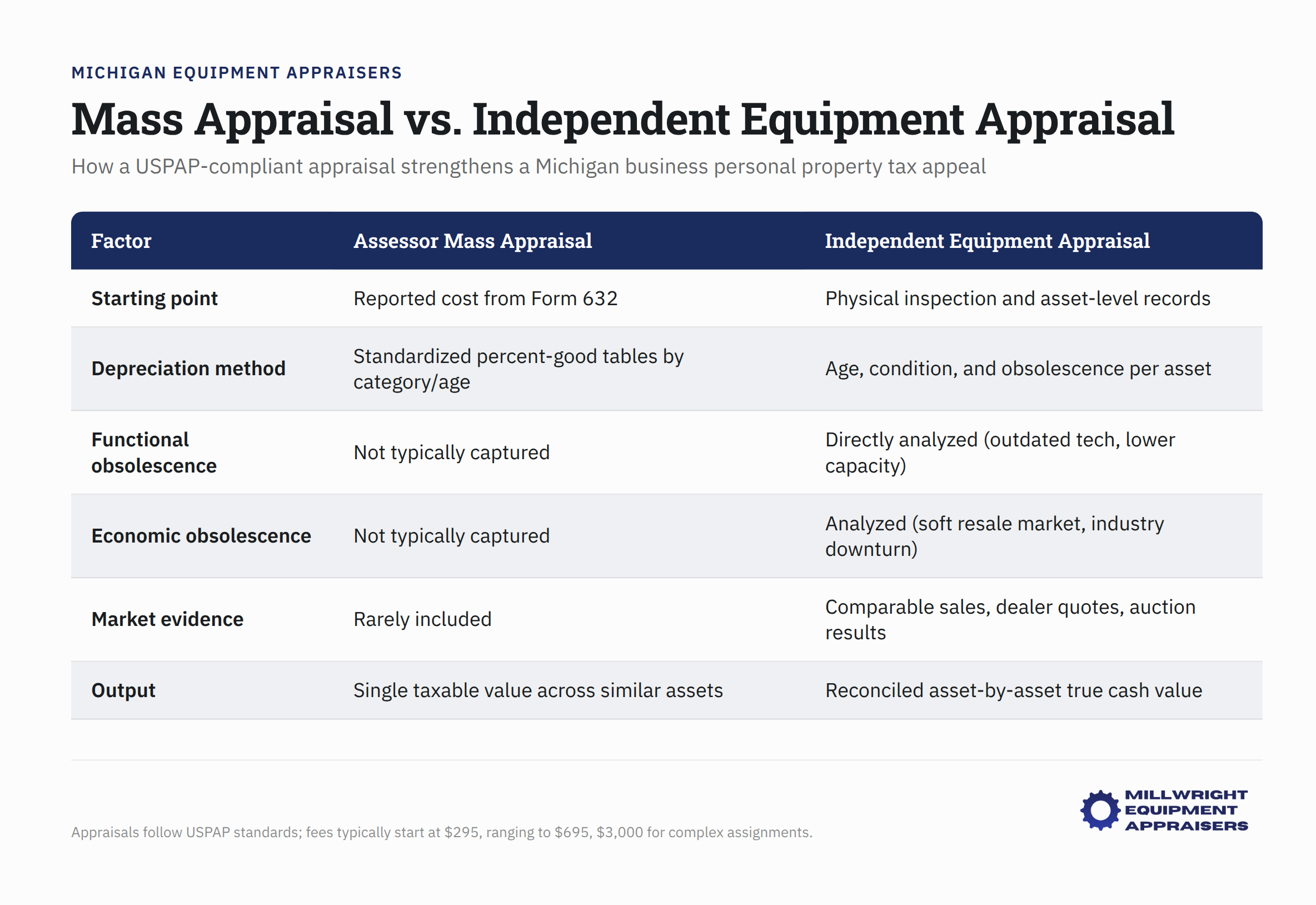
Assessors value business personal property through mass appraisal: they take the cost you reported, apply a standardized depreciation or "percent good" table based on asset category and age, and arrive at a taxable value. That approach is efficient for processing thousands of filings across a jurisdiction, but it's built on averages. It doesn't know that your specific press has been down for repairs more than a comparable machine, that a piece of your equipment is functionally obsolete because newer models run twice the throughput, or that the regional market for used equipment in your category has softened.
An independent, USPAP-compliant equipment appraisal starts from the opposite direction: it looks at your actual machinery, not a category average. Our appraisers hold credentials with organizations such as the ASA, CAGA, and NEBB, and every report follows the Uniform Standards of Professional Appraisal Practice (USPAP), the standard recognized across tax, legal, and financial proceedings nationwide.
| Factor | Assessor Mass Appraisal | Independent Equipment Appraisal |
|---|---|---|
| Starting point | Reported cost from Form 632 | Physical inspection and asset-level records |
| Depreciation method | Standardized percent-good tables by category and age | Age, condition, and obsolescence specific to each asset |
| Functional obsolescence | Not typically captured | Directly analyzed (outdated technology, reduced capacity) |
| Economic obsolescence | Not typically captured | Analyzed (soft resale market, industry downturn) |
| Market evidence | Rarely included | Comparable sales, dealer quotes, or auction results |
| Output | A single taxable value across all similar assets | A reconciled, asset-by-asset true cash value conclusion |
The principal valuation approaches an appraiser applies are the cost approach (replacement cost new less depreciation), which works well for specialized or heavily modified equipment with a thin resale market, and the sales-comparison approach, which relies on arm's-length sales of comparable used equipment adjusted for age and condition. A well-reasoned appraisal explains which approach applies and why, rather than presenting an unsupported number.
Equipment appraisal engagements are quoted as a fixed fee after we scope your asset list, never billed hourly. For standard machinery and equipment appraisals, fees typically start at $295, with more complex assignments involving larger equipment lists or detailed obsolescence analysis typically running $695 to $3,000, depending on the number of assets and the depth of analysis required.
What a Defensible Equipment Appraisal Report Should Include
A report that holds up at the Board of Review or the Tax Tribunal needs to do more than state a number. It should:
- Identify each material item by description, serial number, location, acquisition date, and ownership or lease status.
- Reconcile the company's fixed-asset ledger and Form 632 filing to the physical equipment on the floor.
- Separate taxable equipment from items that were sold, scrapped, transferred, or reported in the wrong local assessing unit.
- Analyze physical condition, maintenance history, remaining useful life, and functional limitations for each category.
- State a value as of the applicable December 31 valuation date, not the date of the inspection.
- Explain the valuation approach used and reconcile it to the assessor's reported figures, line by line.
A depreciation schedule prepared for accounting purposes is not the same thing as a market-value appraisal. Book depreciation follows accounting conventions; true cash value follows what the equipment would actually sell for in the current market. That gap is exactly what a credentialed appraiser is trained to document.
Building Your Case Before the Deadline
Michigan's property tax calendar moves fast: a February 20 filing deadline, a March Board of Review, and a May 31 Tax Tribunal window (or 35 days from a denial notice) don't leave much room to scramble. The businesses that fare best are the ones that get an appraisal scoped and completed before the Board of Review meets, so the evidence is ready the first time they're in the room.
If you've received an assessment notice that overvalues your machinery, request a Michigan equipment appraisal early enough to use it at every stage of the appeal, not just the last one.
This article is provided for general informational purposes only and does not constitute legal, tax, or financial advice. Readers should consult a qualified attorney or CPA regarding their specific circumstances and confirm current filing deadlines with the local assessor or the Michigan Tax Tribunal.